After enough lessons you start to notice the same places coming up. These are the six that give new drivers the most trouble around Vancouver and Burnaby, and none of them are difficult once you know what to expect.
1. Downtown Vancouver's one-way grid
Most of downtown runs one-way, and the direction alternates. Combine that with separated bike lanes, buses pulling out, and pedestrians crossing on every phase, and new drivers get overloaded fast.
How to approach it: plan two turns ahead rather than one. If you miss a turn downtown, take the next one. The grid means you are never more than three blocks from correcting. Never stop mid-block to reconsider.
2. Unprotected left turns on Broadway
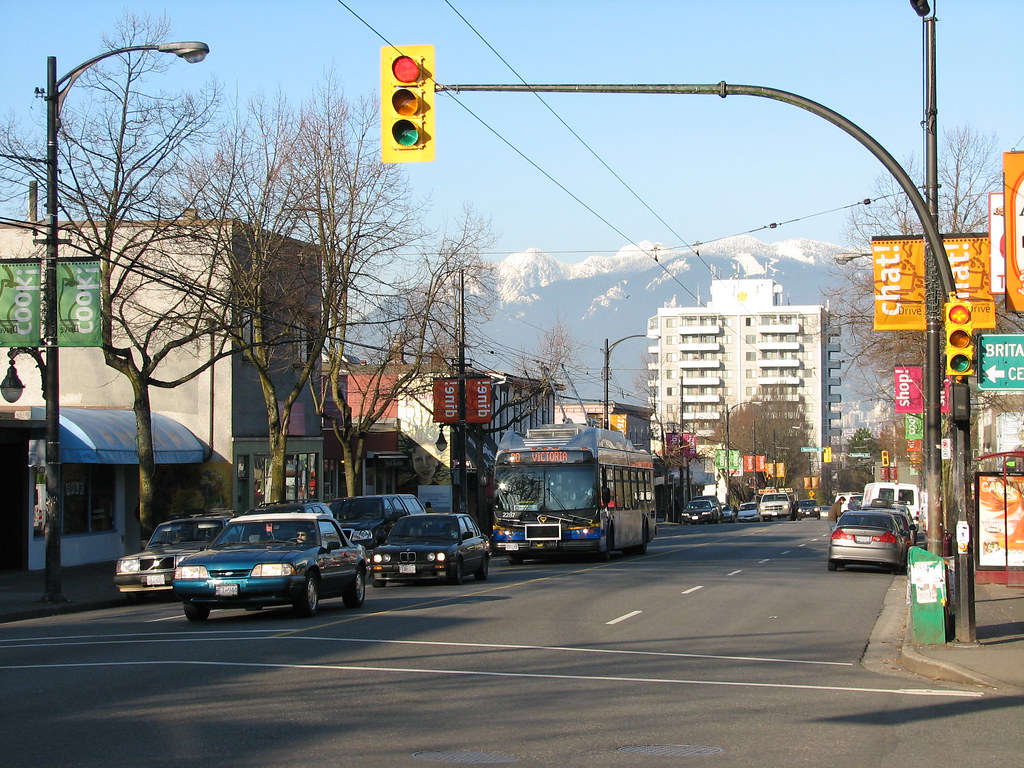
Broadway carries heavy traffic in both directions and many intersections have no dedicated left arrow. You end up waiting in the intersection for a gap that may only appear on the amber.
How to approach it: if you are already waiting in the intersection to turn left and the light changes to yellow, wait until oncoming traffic has stopped and complete the turn when it is safe. Always watch for vehicles entering the intersection late.
3. The hills through Point Grey and Dunbar
West-side Vancouver has genuinely steep residential streets, and hill parking is a road test manoeuvre. Rolling backwards on a hill start is one of the most common single-point losses.
How to approach it: in an automatic, move your foot from brake to accelerator in one motion rather than pausing. Some roll-back is tolerated; a metre is not.
4. Merging onto Lougheed Highway in Burnaby
The on-ramps are shorter than they look and the through traffic is moving at 80 km/h. New drivers tend to enter too slowly, which is more dangerous than entering too fast.
How to approach it: get to the speed of traffic on the ramp, not after you join. Pick your gap early, shoulder check once, and commit. Stopping at the end of a merge lane is the worst possible outcome.
5. Metrotown at peak hours
Multiple lanes merging in short distances, buses pulling across, cars emerging from parking structures, and constant pedestrian traffic. It is the densest concentration of hazards in Burnaby.
How to approach it: increase your following distance and look further ahead than feels necessary. Almost everything that goes wrong here is visible three or four seconds in advance.
6. Kingsway, anywhere along its length
Kingsway is wide, fast, and has frequent signals with cars turning across it. Lane discipline slips easily, and it crosses the Vancouver–Burnaby boundary. These roads provide useful practice for the types of traffic conditions students may encounter during a road test.
How to approach it: pick a lane early and stay in it. Weaving to gain one car length reads as poor planning to an examiner, and you gain nothing. The next light equalises it anyway.
The pattern
Every one of these rewards the same thing: looking further ahead. New drivers watch the car in front. Experienced drivers watch four cars ahead, and the crosswalk beyond that. It is also precisely what road test examiners are scoring when they mark "observation".
If you would rather work through these with an instructor beside you, we teach across both cities. See driving lessons in Vancouver or driving lessons in Burnaby.